
Succulent
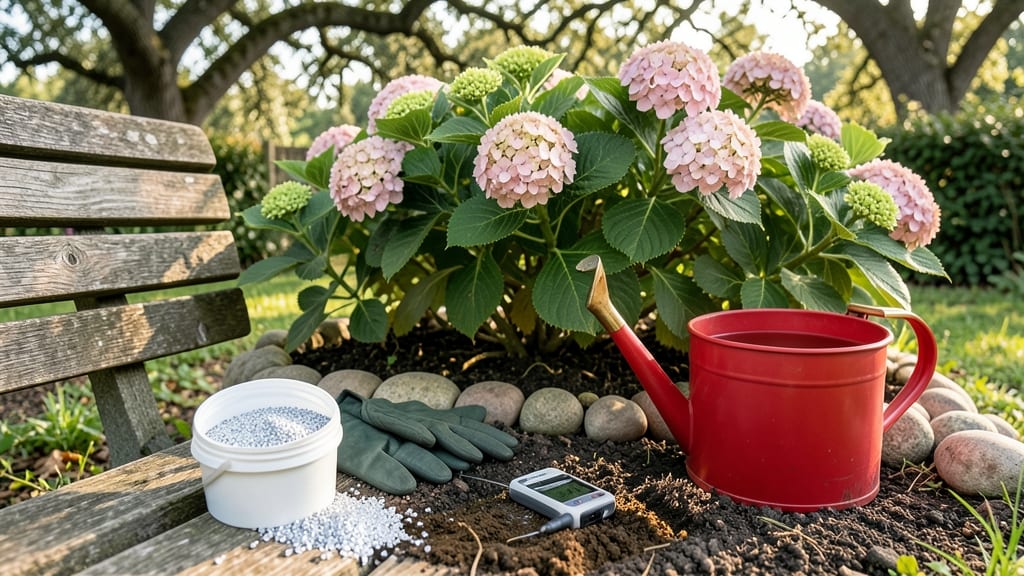
How to change those pink hydrangeas to blue with just a little soil science. 💙 The secret lies in adjusting your soil's pH—something I learned after my first attempt left me staring at stubborn pink blooms. Hydrangeas change color based on acidity, and with the right approach, you can transform your garden's focal point overnight (well, almost).
The magic number is pH 5.5 or lower—that's the sweet spot for blue blooms. You'll need aluminum sulfate (about 1-2 pounds per plant), a pH testing kit, and patience. Most people overshoot the amendment, so start small and test your soil before blooming season.
This isn't a quick fix—it takes 2-3 months to see results, but the payoff is worth it.
Imagine those deep cobalt blooms standing out against your garden's greenery—it's like giving your plants a whole new personality. The key is consistency: test your soil every few weeks and reapply amendments if needed.
I've seen hydrangeas shift from pale pink to rich blue in just one season with proper care.
Works for bigleaf hydrangeas (Hydrangea macrophylla) and some oakleaf varieties, but check your plant type first. Spring is the best time to start, but you can adjust anytime before buds form. Let's get those blues blooming!
📚 In This Guide
- What you need
- Instructions
- Tips and common mistakes
- Wrapping up and next steps
What you need
- ● Aluminum sulfate – 1–2 pounds per 100 sq ft of soil (for acidic soil adjustment). Choose a hydrangea-specific or garden-grade product (e.g., Alum-A-Sol or Aluminum Sulfate Crystals).
- ● Peat moss or pine bark fines – 2–3 gallons (to lower soil pH naturally). Opt for sphagnum peat moss for best results.
- ● Garden trowel or spade – For mixing amendments into the soil.
- ● Gloves and protective eyewear – To handle aluminum sulfate safely (it’s a powder that can irritate skin and eyes).
- ● Watering can or hose – For thorough irrigation after application.
- ● Soil pH test kit – To monitor progress (e.g., Luster Leaf Rapitest or digital meters). Aim for a pH of 5.0–5.5 for blue blooms.
- ○ Mulch (optional but recommended) – 2–3 inches of pine needles or oak leaves to maintain acidity and retain moisture.
- ● Soil pH adjuster spray – Pre-mixed liquid formulas (e.g., Down to Earth Acid Mix) for easier application.
- ● Compost or well-rotted manure – 1–2 gallons to enrich soil while keeping it acidic.
- ● Rain gauge or moisture meter – To track watering consistency (hydrangeas need consistent moisture for color changes).
- ● Labeling flags – To mark treated areas and track progress over weeks.
Step-by-Step instructions for transforming pink hydrangeas to blue
Here's the method I've used to shift hydrangea blooms from pink to vibrant blue—it's all about soil chemistry and patience.
🌱 Step 1: Test Your Soil's Current pH Level
Before making changes, grab a soil pH test kit from your local garden center. Hydrangeas thrive in acidic soil (pH 5.0-5.5) for blue blooms, but most garden soils hover around neutral (pH 7.0). Dig a 6-inch deep sample near your hydrangeas, avoiding any mulch layer. Follow the kit instructions to determine your current pH—this tells you exactly how much adjustment you'll need.
I've seen gardeners skip this step and add too much sulfur or aluminum sulfate, which can actually harm the plant. Think of it like adjusting a recipe: you wouldn't add salt without tasting first. If your pH is already below 5.5, you might need to focus on other factors like watering or nutrient balance instead.
💧 Step 2: Apply Acidifying Amendments to the Soil
For hydrangeas with pink blooms, you'll need to lower the pH. The most effective method is applying elemental sulfur at a rate of 1-2 pounds per 100 square feet of soil. Sprinkle it evenly around the plant's dripline (the area where water naturally drains from the leaves), keeping it 3-4 inches away from the stem to prevent burning the roots.
Water the area thoroughly after application—this helps the sulfur dissolve and penetrate the soil. You'll want to re-test the pH in 2-3 months because soil acidification takes time. I've found that adding sulfur gradually gives more predictable results than dumping it all at once, which can create hot spots that harm roots.
☀️ Step 3: Incorporate Organic Acidifiers for Long-Term Balance
While sulfur works quickly, organic acidifiers like pine needles, oak leaves, or peat moss provide a slower, more natural pH adjustment. Spread a 2-3 inch layer of these materials around the base of your hydrangea, but don't pile them against the stem. As they decompose, they'll gradually acidify the soil without the risk of over-acidification.
This method is especially useful if you want to maintain blue blooms year after year. The organic matter also improves soil structure and moisture retention. I like to refresh this mulch layer every spring—it's a low-maintenance way to keep the soil chemistry just right for those stunning blue flowers.
⏰ Step 4: Monitor and Maintain Soil pH Regularly
After your initial adjustments, test the soil pH every 3-4 months during the growing season. Hydrangeas need consistent acidity to produce blue blooms, and soil pH can drift over time. If the blooms start reverting to pink, it's a sign you need to re-acidify. I keep a small notebook near my garden tools to track pH readings and amendment dates—it's saved me from overcorrecting multiple times.
Remember that hydrangeas need at least 6 hours of sunlight daily and 1-1.5 inches of water per week for optimal growth. Proper hydration helps the plant absorb nutrients more efficiently, which supports vibrant blue blooms. If your hydrangea looks stressed (yellow leaves, wilting), focus on improving water and nutrient conditions before worrying about pH adjustments.
🌿 Step 5: Be Patient and Observe Flower Color Changes
Don't expect dramatic color changes overnight. It can take 6-12 months for hydrangeas to fully adjust to the new soil chemistry and produce blue blooms. The first year, you might see some flowers shift color while others stay pink—that's normal. The key is consistency in your soil maintenance.
Watch for other visual cues: blue hydrangea blooms should have a deeper, richer hue compared to their pink counterparts. The leaves should remain dark green and healthy, not yellow or spotted. If you see new growth with pink flowers, it's a sign the soil pH hasn't dropped enough yet—time to test and adjust again.
Tips & tricks for transforming pink hydrangeas to blue
These targeted strategies will help you achieve that coveted blue bloom transformation—without the guesswork.
Precision Testing Pays Off: When testing your soil pH in Step 1, take multiple samples from different areas around your hydrangea. Soil pH can vary dramatically even within a small garden space. I've seen cases where one side of the plant's root zone tested at pH 6.2 while the other side was at 7.0—this inconsistency explains why some flowers turned blue while others remained pink. Aim for consistent readings across all samples before making adjustments.
Gradual Acidification Strategy: The instructions mention applying 1-2 pounds of elemental sulfur per 100 square feet, but here's what I've learned: split that first application into two doses, two weeks apart. This prevents sudden pH shocks that can stress your hydrangea. After the initial application in Step 2, wait until your 2-3 month pH test shows the pH has dropped about 0.5 points before adding the second dose. Think of it like seasoning a dish—you want flavor development, not overwhelming acidity.
Organic Layering Technique: For the organic acidifiers in Step 3, I recommend layering pine needles and oak leaves in alternating 1-inch layers rather than mixing them uniformly. The pine needles break down faster and provide immediate acidification, while the oak leaves offer long-term soil structure improvement. Refresh this layer every spring by adding new material on top of the existing decomposed layer—this maintains consistent acidification without disturbing the plant's roots.
Visual pH Tracking: Beyond the numerical pH readings, pay attention to these visual cues during your 3-4 month monitoring in Step 4: healthy blue hydrangea leaves should have a slightly darker green hue than pink-flowering varieties. If you notice yellowing between the veins (interveinal chlorosis), this indicates iron deficiency caused by overly acidic conditions. In this case, you may need to slightly raise the pH by adding a small amount of lime to the soil—just enough to eliminate the yellowing while maintaining the blue blooms.
Pro Tips for Change Pink Hydrangeas To Blue
- These targeted strategies will help you achieve that coveted blue bloom transformation—without the guesswork.
- Precision Testing Pays Off: When testing your soil pH in Step 1, take multiple samples from different areas around your hydrangea.
- Gradual Acidification Strategy: The instructions mention applying 1-2 pounds of elemental sulfur per 100 square feet, but here's what I've learned: split that first application into two doses, two weeks apart.
Frequently asked questions
Got questions about transforming your pink hydrangeas into stunning blues? Here are some of the most common ones—and their answers!
Why won’t my hydrangeas turn blue even after adding aluminum sulfate?
This could be due to a few factors: pH levels aren’t acidic enough (aim for 5.2–5.5), soil isn’t well-draining (waterlogged soil can neutralize acidity), or you’re not applying enough aluminum sulfate. Test your soil first with a kit to confirm pH, and reapply the sulfate if needed—patience is key! Results take 4–6 weeks.
How long does it take to see blue blooms after changing soil pH?
You’ll typically see color changes within 4–6 weeks after adjusting soil pH, but full transformation can take up to 3 months, especially for mature plants. New growth will reflect the new pH first—old flowers won’t change color. Be consistent with maintenance to lock in those blues!
Does rain wash away the aluminum sulfate, or do I need to reapply often?
Rain can dilute the aluminum sulfate, so reapply every 2–3 months or after heavy rainfall. For a long-term fix, mix aluminum sulfate into the soil during planting or top-dress with elemental sulfur (which slowly acidifies soil). Mulch with pine needles or peat moss to help retain acidity between treatments.
Can I use vinegar or coffee grounds to turn hydrangeas blue?
While vinegar (white vinegar diluted to 1 part vinegar : 4 parts water) and coffee grounds can lower soil pH, they’re not as reliable or consistent as aluminum sulfate. Vinegar’s effects are temporary (lasts ~2 weeks), and coffee grounds work best when composted first to avoid mold. For guaranteed results, stick with aluminum sulfate or sulfur.
What happens if I over-acidify the soil? Will it harm my hydrangeas?
Over-acidifying soil (pH below 5.0) can stress hydrangeas, leading to yellowing leaves, stunted growth, or even root damage. To fix it, amend the soil with lime (calcium carbonate) to raise pH gradually. Monitor soil pH regularly with a test kit, and adjust slowly—hydrangeas thrive in slightly acidic soil (5.2–6.2).
Can I change hydrangea color back to pink if I don’t like the blue?
Yes! To shift back to pink, raise the soil pH to 6.0–7.0 by adding garden lime or wood ash. It may take 2–3 months for new growth to reflect the change. Pro tip: Test soil pH before and after to avoid overshooting—hydrangeas can also produce purple blooms at neutral pH!
Wrapping up and next steps
Transforming your pink hydrangeas into stunning blues is all about patience, consistency, and a little soil science magic! 🌸 By adjusting pH levels with aluminum sulfate or composted pine needles, you’re not just changing colors—you’re giving your plants the perfect growing conditions.
Remember, results take time, but the reward of vibrant blue blooms is worth every effort.
Ready to see the difference? Start testing your soil’s pH today—your hydrangeas (and your garden’s curb appeal!) will thank you. Happy gardening! 🌿